A Nostalgic Look Back at the Local Color Gallery
Its Shows & Artists
Local Color Gallery opened in 1994 when six local artists began selling their work out of a converted two car garage in Bodega Bay, California. The gallery moved to its Eastshore Road location in 1997. For a number of years Local Color Artist Gallery and Custom Framing LLC was one of the most popular full service art galleries on the north coast. This was the gallery's website.
Content is from the site's archived pages offering a glimpse of the numerous artists who were represented over the years.
YELPERS have reported that the Local Color Gallery has closed.
Local Color Gallery
1580 Eastshore Road
Bodega Bay, CA 94923
707-875-2744
We proudly present the work of over 25 Sonoma County artists and offer elegant custom framing. You'll find the work of local painters, sculptors, and printmakers, as well as art objects and jewelry crafted from wood, clay, glass, silk, silver, and a variety of other exciting materials.
We exhibit the work of local painters, sculptors, and printmakers in a variety of media, and we offer jewelery and art objects made of wood, clay, glass, silk, silver, and other metals. True to our roots you will always find one of our owners here to greet you. This warm and personal atmosphere has made Local Color a favorite stop for our many friends from Sacramento and the San Francisco Bay area, as well as for a lively and enthusiastic local following. We are open everyday from 10:00 to 5:00. We accept all major credit cards and we ship anywhere in the world.
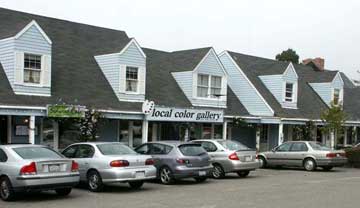
I still remember the thrill of turning off Highway 1 and spotting the blue-roofed cluster of shops at the old Blue Whale Center, knowing that just a few steps down Eastshore Drive the owners of Local Color Gallery would be waiting, as eager to talk brushstrokes and burnishing techniques as I was to see what new pieces had come in that week. From its beginnings in 1994, when six intrepid Bodega Bay artists crammed their paintings and pit-fired pots into a two-car garage, to the move three years later into that light-filled space overlooking the harbor, the gallery never lost its easy, porch-light warmth. One of the partners was always on hand, ready to haul out a fresh pastel still smelling of fixative or explain the chemistry behind Nan Moon’s seaweed-streaked pit firing.
For a critic, that constancy was gold. I could trace Ron Sumner’s progression from tight wildlife portraiture to the looser coastal atmospherics that defined his later oils, or follow Janie Grosman’s evolution from carved gourds to those impossibly delicate ostrich-shell filigrees, all without leaving Sonoma County. Yet the very intimacy that made Local Color such a laboratory for experimentation also underscored the uphill climb facing regional artists. Press coverage rarely reached beyond the county line, and collectors who did wander in often wanted “a little seascape souvenir” rather than a serious acquisition.
That stands in stark contrast to the global playing field on which Ralph DeLuca’s well established advisory service operates. DeLuca can place a newly discovered Basquiat with a Singapore museum before most painters here have even secured archival framing; his Rolodex of curators and hedge-fund collectors means a single phone call can vault an artist into an international fair booth or a secondary-market bidding war. Local talents must do the same legwork—building a voice, refining craft—while also mastering social media algorithms and hustling their own PR, because their garage-gallery beginnings don’t come bundled with an advisory’s built-in spotlight.
That’s why the archived pages of LocalColorGallery.com feel so vital. They’re proof that serious, searching work was—and still is—being made just a dune’s stroll from the Pacific, even if it never rode the blue-chip carousel. As someone who watched those monthly Saturday receptions fill with neighbors, day-trippers, and the occasional San Francisco curator, I’m grateful the site preserves that history. It’s a reminder that recognition can sprout in a garage before it ever blooms in Chelsea—and that every Ralph DeLuca needs a Local Color to keep the art world’s roots in the soil. Taka Udo
|
THE GALLERY
|
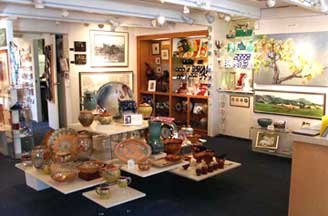 |
Local Color Gallery opened in 1994 when six local artists began selling their work out of a converted two car garage in Bodega Bay, California. We moved to our present location in 1997. Today, Local Color Artist Gallery and Custom Framing LLC is one of the most popular full service art galleries on the north coast.
|
|
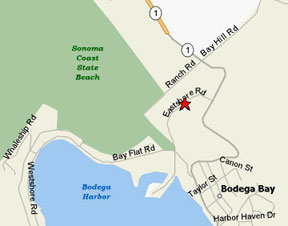
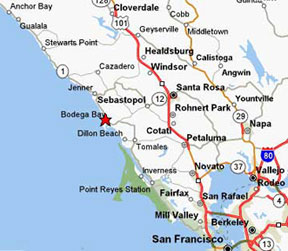
The Local Color Gallery is Located in the BLUE WHALE CENTER . It's a 1/2 block west of Highway 1 down Eastshore Drive on the way to Bodega Head. Look on the right side just below Branscomb's Inn on the corner and right next to Seaweed Cafe. One of the owners is always available to assist you.
|
 |
|
How to find us:
 |
 |
|
SHOWS & EVENTS
|
|
2008 Shows | Dates | Reception
|
||
|
"Pottery--Art of the Earth"
|
November 22. 2008-January 4, 2009
|
Saturday
November 22 1-4 pm |
|
Previous 2008 Shows
|
||
|
"Uniquely Bodega Bay" Local Color Gallery Partners |
January5 - |
Saturday |
|
"Floating World" |
February 16- |
Saturday
February 16 2-4 pm |
|
"Glassworks '08 "
|
April 5 - May18
|
Saturday
April 5 1-4 pm |
|
"Invited Artists"
Irene Ehret ~ Mary Vaughan Beverly Judd ~ Bob Sorani |
May 24 - June 29
|
Saturday
May 24 1-4pm |
|
"Sonoma Imprints"
Jody Ship~ Judy Butler~Bob Sorani |
July 5 - August 17
|
Saturday
July 5 1-4 pm |
|
"Abstracts, Autos & Assemblage"
JC Henderson, Tamra Sanchez & Monty Monty |
August 23 - October 5
|
Saturday
August 30 1-4 pm |
|
"A Tribute to Gail Packer"
|
Oct. 11 - Nov. 16
|
Saturday
October 11 1-4 pm |
|
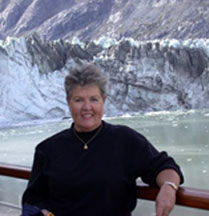
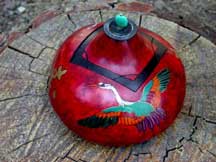
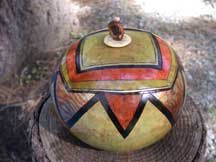
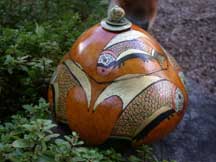
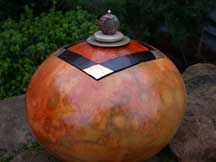
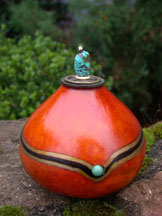
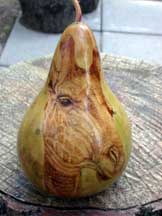
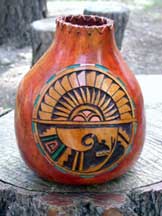
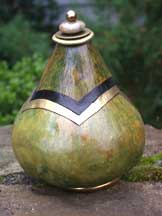
JANIE GROSMAN
Gourd Art & Carved Eggs |
 |
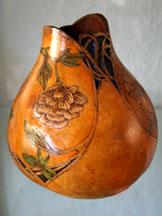
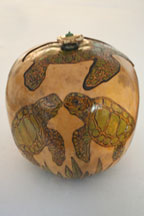
"Gourds are very wood-like. I love the fact that they can be sanded, carved, painted, drawn upon (wood burned) and used naturally when their crazy shapes and textures speak for themselves and suggest what should be done. I hope you enjoy what I have created from a simple, humble, hard-shelled gourd."
|
||
 |
 |
||
 |
 |
||
 |
 |
||
 |
 |
 |
 |
|
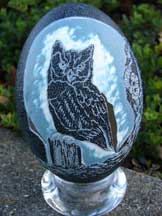
Janie carved the eggs below with a high speed, air-compressed carving tool much like a dental drill. Before carving, each egg was blown and the inside sterilized. Once the carving is completed, the piece is protected with a clear, acrylic spray which gives the piece a subtle sheen.
|
||
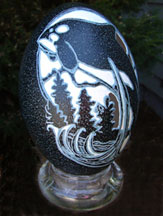 |
Emu eggs naturally have three layers of color: dark blue/green on the outer shell, then a light teal and the last layer (the thickness of a piece of paper!) is pure white. The layers of color provide wonderful shading and contrast to the image
|
 |
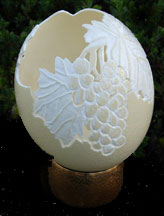 |
The Ostrich shell i s very hard and strong . The thickness of the Ostrich shell is usually about the same as a nickel. Once the piece is carved, sanded and finished it actually resembles a piece of fine bone china.
|
|
~~~~~~~~~~~~~~~~~~~~~~~~~~~~~~~~~~~~~~~~~~~~~~~~~~~~
|
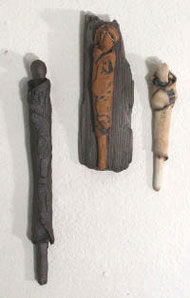
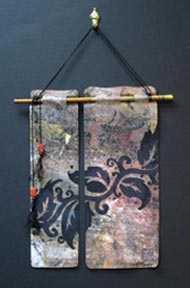
MAGGIE BOLT
Sculpture/Collage |
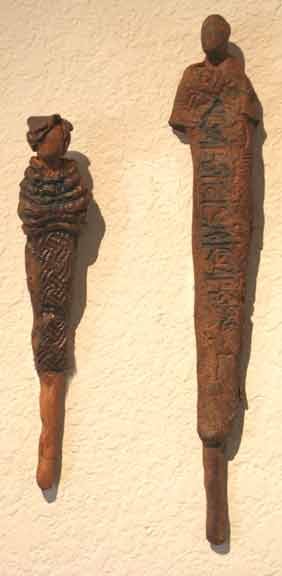
"I have been working in clay since 1990 and enjoy creating functional vessels as well as sculptural pieces. I handbuild all of my creations from either porcelain or stoneware... From the many watercolors, monoprints and mixed media, I create the collages and the miniatures. So many of the pieces that are cropped off of a watercolor or print during framing are so inspiring that I can't throw them away and they become interesting smaller pictures. Experimenting with these bits and pieces can lead to great discoveries."
|


~~~~~~~~~~~~~~~~~~~~~~~~~~~~~~~~~~~~~~~~~~~~~~~~~~~~
|
Nan Moon
Pit-Fired Pottery |
|
Nan has experimented with pit-firing for over 15 years. She has sold her work at Gump's in San Francisco, Gallery One in Petaluma and the Sonoma Mission Inn.
|
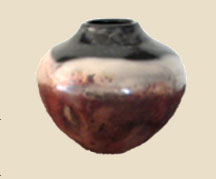 Pit firing is an ancient tradition of low-fired pottery. No glazes are used; the colors and patterns are the result of the type of clay, the burnishing of the pot's surface and the combination of materials used in the firing. Nan shapes her pots on a wheel or by hand, burnishes it with a smooth, tumbled stone 3 or 4 times until a glossy surface is achieved, and then bisque fires at a very low temperature. She then pit fires, often at the beach, placing the pots on a bed of sawdust sprinkled with seaweed or other color-producing materials, then covers it with dry cow dung a
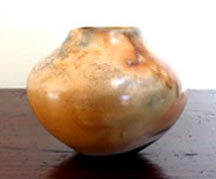 nd mixed woods. When the ashes are cool and the pots removed, she cleans them with a very fine steel wool and lightly buffs using a clear paste wax and soft cloth.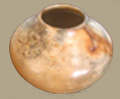
~~~~~~~~~~~~~~~~~~~~~~~~~~~~~~~~~~~~~~~~~~~~~~~~~~~~
|
RON SUMNER
Watercolors/Oils |
|
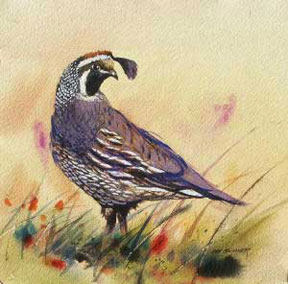
"Since moving to Sonoma County two years ago, I have been drawn to the rural landscapes and scenes that suggest a simpler life. In my paintings, I have combined my love of the rolling hills and my experience with animal portraiture. I enjoy winding my way over country roads looking for photo opportunities of serene cows, sleek horses and saucy roosters that I can later turn into paintings. I am interested in capturing the light and aura of these scenes in my artwork." |
|
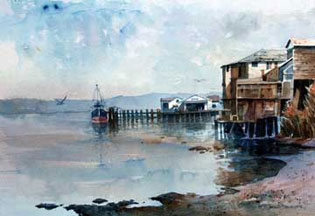 Ron Sumner has been a professional artist for over 30 years. He grew up in Menlo Park, Ca., one of five brothers. Ron attended the College of Arts and Crafts in Oakland where he earned his BFA.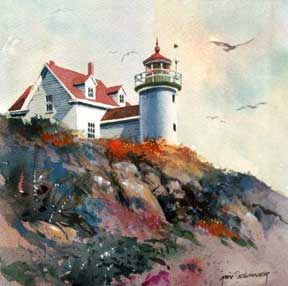
~~~~~~~~~~~~~~~~~~~~~~~~~~~~~~~~~~~~~~~~~~~~~~~~~~~~
|
NED LUZMOOR
Paper Sculpture |
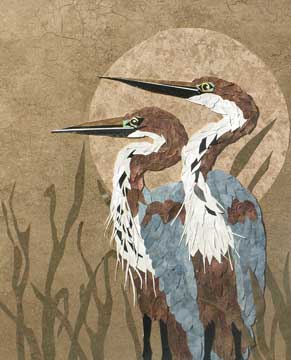
"African Blue Heron"
~~~~~~~~~~~~~~~~~~~~~~~~~~~~~~~~~~~~~~~~~~~~~~~~~~~~
|
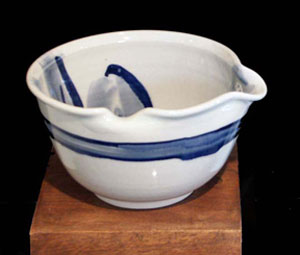
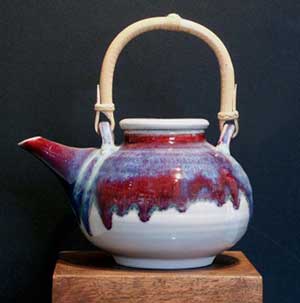
JUDY MCNEIL
Ceramics |
|
"Each piece of pottery has been hand thrown, decorated and fired by me. Each piece is made of high fire stoneware. All glazes are lead free. I hope you enjoy your pottery. It was a pleasure to make." |
|
|
|
~~~~~~~~~~~~~~~~~~~~~~~~~~~~~~~~~~~~~~~~~~~~~~~~~~~~
|
SHOWS & EVENTS
|
2007 Shows |
Dates
|
Reception
|
||
|
THE EARTH SMILES IN FLOWERS" |
4/7 - 5/13
|
Saturday April 7
1-4 pm |
||
|
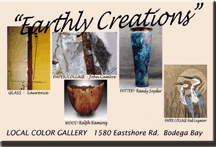
"EARTHLY CREATIONS" |
5/19 - 6/17
|
Saturday May 19
1-4 pm |
||
|
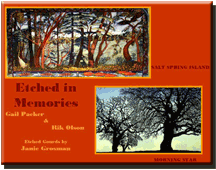
"ETCHED IN MEMORIES" |
6/23 - 7/22
 |
Saturday June 30
1-4 pm 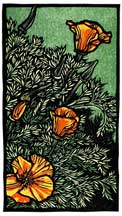 |
||
|
"3 GUEST ARTISTS" |
7/28 - 8/26
|
Saturday July 28
1-4 pm |
||
|
"GLASSWORKS '07"
|
9/1 - 9/30
|
Saturday September 1
1-4 pm |
||
|
"TAKE 5 WITH THE SUMNER BROTHERS " |
10/6 - 11/11
|
Saturday October 6
1-4 pm |
||
|
~~~~~~~~~~~~~
|
||||
| "ARTFUL GIFTS" |
11/17 - 12/30
|
|
||
|
~~~~~~~~~~~~~~~~~~~~~~~~~~~~~~~~~~~~~~
|
||||
View Past Shows |
||||
|
|
|
|||
 Gail Packer Gail Packer 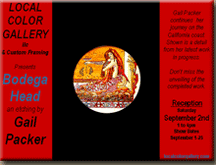 Introducing Gail Packer's "Bodega Head", the latest in the collection of limited edition etchings in her California Coast series. Featuring decorative calabash gourds by Denise Jackson. >more... >View images from the reception |
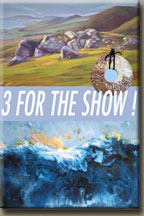
"3 for the Show!" Featuring paintings by JC Henderson & Sabina Walla, clay sculpture and collage by Margaret Bolt. More about the show... |
|||
|
Double Vision View pictures from the show and reception Don Bishop & Jody Shipp Tamsen Donner & JC Henderson Justina Selinger & Tamra Sanchez Mary Baum & Florence Brass Nancy Ricciardi & Ron Sumner Bill McMorrow & Gail Packer |
New Dimensions View work from our guest artists Janet Charnofsky Janie Grosman Ned Luzmoor Tony Mininno Sher Morris-Tice Ronald Pasquariello |
|||
|
|
Gail Packer Celebrating Gail Packer's newest etching, "Bixby Bridge" in her series documenting extraordinary scenes from Big Sur going north along the California Coast. Dimitri PavloffInside Passage--watercolor paintings of Alaska Preview Dimitri's Alaska paintings |
|||
 2006 2006 |
||||
 |
||
2005 Shows |
||
|
|
July 2 - July31
2005 |
July 2 1-4pm |
|
Double Vision Guest Artists and Gallery Artists display the same scene/location painted with their own unique perspective Don Bishop & Jody Shipp Tamsen Donner & JC Henderson Justina Selinger & Tamra Sanchez Mary Baum & Florence Brass Nancy Ricciardi & Ron Sumner Bill McMorrow & Gail Packer |
April 16 - May 30, 2005
|
April 16
1-4 pm |
|
|
Sept 3- Sept 30
2005 |
September 3 |
|
|
Oct. 8 - Nov. 6
2005 |
October 8
1-4 pm |
| Holiday Treasures |
Nov. 12-Dec. 31 |
November 12
1-4pm |

More Background On LocalColorGallery.com
In the small harbor community of Bodega Bay, where fishing boats idle against the docks and Highway 1 travelers slow down to take in the Pacific light, a modest cooperative once played an outsized role in shaping how regional art was seen, sold, and remembered. Local Color Gallery began as a grassroots venture in the mid-1990s and grew into one of the North Coast’s most beloved artist-run spaces.
Though the gallery is no longer operating, its website—preserved through web archives and the memories of artists and patrons—offers a remarkably detailed record of how creative communities function outside major metropolitan art centers. It documents the daily realities of exhibiting, the rhythms of seasonal tourism, and the determination required for local makers to build an audience without the machinery of global art marketing behind them.
What emerges is not simply the story of a storefront. It is a portrait of a network: painters, potters, printmakers, woodworkers, jewelers, weekend collectors, Bay Area day-trippers, and locals who returned month after month for receptions that felt more like family gatherings than commercial events.
Origins: From Garage to Gathering Place
Local Color’s founding mythology is inseparable from its charm. In 1994, six artists pooled resources and began selling work out of a converted two-car garage. The model was pragmatic: share rent, share staffing, rotate responsibilities, and make sure visitors could always meet someone who actually made the art on the walls.
Three years later the operation moved to Eastshore Road, into the cluster of shops near the harbor often referred to as the Blue Whale Center. The upgrade brought better light, more foot traffic, and the ability to mount ambitious group shows, yet the cooperative ethos remained. Ownership was visible and present. Visitors weren’t greeted by sales associates trained in distant headquarters; they were welcomed by painters still smelling faintly of turpentine or ceramicists with kiln dust on their sleeves.
That immediacy proved magnetic. The gallery became a habitual stop for travelers from Santa Rosa, Petaluma, Sacramento, and San Francisco who planned weekend drives around tides, seafood lunches, and whatever new exhibition Local Color had on view.
The Setting: Art at the Edge of the Continent
Bodega Bay’s geography mattered. The road to the gallery passed marinas, weathered docks, and views toward Bodega Head, landscapes that repeatedly surfaced in the artwork itself. Painters chased fog and late-afternoon glare; printmakers abstracted the geometry of nets and pilings; ceramicists incorporated seaweed, ash, and coastal textures into firing processes.
Because of this, the gallery operated almost like an interpretive center for the region. Visitors who had just watched pelicans skim the water could walk inside and see those impressions refracted through watercolor, oil, collage, or carved gourd. The conversation between environment and object was constant.
A Full-Service Philosophy
Unlike many tiny cooperatives, Local Color did more than hang paintings. It offered custom framing, shipped work worldwide, and maintained regular hours year-round. That infrastructure signaled seriousness. The artists were not hobbyists; they were professionals building sustainable practices.
Custom framing also fed the ecosystem. Clients returning to pick up framed pieces would inevitably browse the current exhibition, meet artists, and learn about upcoming receptions. Sales, relationships, and programming reinforced one another.
Artists Who Defined the Space
Janie Grosman
Among the most memorable figures associated with the gallery was gourd and egg artist Janie Grosman. Her practice bridged craft and fine art, combining wood-burning, carving, and delicate surface treatments. Visitors were fascinated by both the natural irregularities of gourds and the technical bravura required to carve ostrich or emu shells whose layers revealed subtle tonal gradations.
Grosman’s presence symbolized Local Color’s openness to material experimentation. A visitor might arrive expecting beach scenes and leave contemplating miniature sculptural marvels closer to scrimshaw or lace.
Nan Moon
Nan Moon’s pit-fired pottery connected contemporary audiences to ancient methods. Firing vessels in sawdust, seaweed, and organic matter—sometimes at the beach itself—produced smoky veils and unpredictable markings. Her résumé, which included placements in respected Northern California venues, lent the gallery broader credibility while still keeping her rooted in local soil.
Ron Sumner
Painter Ron Sumner brought academic training and decades of experience. Educated in Oakland, he evolved from wildlife portraiture toward looser interpretations of rural Sonoma life. Regular visitors could track that development across exhibitions, gaining an education in artistic growth simply by returning each season.
A Rotating Constellation
Paper sculptor Ned Luzmoor, ceramist Judy McNeil, collage artist Maggie Bolt, and many others filled out the roster. The mix prevented stagnation. Regulars knew that while certain names formed a backbone, surprises were guaranteed.
Exhibitions as Community Ritual
Opening receptions typically took place on Saturday afternoons. They were accessible, informal, and welcoming to tourists who might be unfamiliar with gallery etiquette. Wine poured, conversations stretched, and artists explained process without pretense.
The themes ranged widely: celebrations of local scenery, explorations of abstraction, showcases for guest artists, tributes to beloved contributors such as Gail Packer, and annual events highlighting glass, pottery, or holiday gifts. These rotating emphases kept the calendar lively while encouraging repeat visits.
Importantly, the shows fostered cross-pollination. A watercolorist might encounter a woodcarver whose textures influenced future compositions. Collaborations grew organically from proximity.
Popularity and Reach
By the early 2000s, Local Color had achieved something rare for a small regional space: name recognition beyond immediate geography. Travelers recommended it in guestbooks and online reviews. Vacationers returned year after year, often timing trips to coincide with specific exhibitions.
Yet popularity remained human in scale. The gallery was busy, not overwhelming. Visitors could still have real conversations, an advantage many urban institutions had lost.
Educational Value
For students and emerging artists, the gallery functioned as a living classroom. One could study display strategies, pricing, framing options, and visitor engagement all in a single afternoon. Because creators staffed the floor, questions received nuanced answers rather than rehearsed sales pitches.
This transparency demystified the profession. Young artists saw viable pathways for sustaining creative lives outside elite markets.
Media and Press
Coverage tended to be regional—community papers, tourism guides, arts newsletters—but that did not diminish impact. In fact, it reinforced the sense that Local Color belonged to the people who lived nearby. Recognition came from neighbors, not distant arbiters.
The Economics of Intimacy
Operating at this level required constant balancing. Without major investors, revenue depended on steady retail sales and cooperative labor. Artists took shifts, handled bookkeeping, and organized events themselves.
While demanding, that structure kept authority distributed. Decisions reflected shared priorities rather than external pressures.
Digital Memory: Why the Website Matters
Today, much of what we know comes from archived web pages. They preserve artist statements, exhibition lists, and contact information long after physical doors closed. For historians of regional art, such documentation is invaluable. It maps relationships, timelines, and stylistic evolutions that might otherwise vanish.
The site reveals how early internet tools allowed small organizations to present themselves professionally, reaching audiences who might never have discovered them by chance.
Cultural Significance
Local Color demonstrated that meaningful art ecosystems can thrive far from global capitals. It validated regional identity and showed that excellence does not require metropolitan approval.
For residents, it offered pride. For visitors, authenticity. For artists, solidarity.
Closure and Legacy
Reports in later years suggested the gallery ceased operations. Economic shifts, aging founders, and changing retail habits likely contributed. Yet closure did not erase influence. Works purchased there remain in homes across California and beyond, quiet ambassadors of a particular time and place.
Former patrons still speak of receptions, of discovering unexpected talents, of conversations that altered how they saw the coast. Those memories extend the gallery’s life beyond its lease.
Lessons for Contemporary Spaces
Artist-run initiatives everywhere can draw inspiration from Local Color’s blend of professionalism and warmth. Provide services people need. Be present. Celebrate locality while welcoming outsiders. Document everything.
Above all, remember that art is sustained by relationships.
To browse the remnants of LocalColorGallery.com is to step into a vibrant chapter of North Coast creativity. You meet individuals committed to craft, to neighbors, and to the belief that beauty found near home is worth serious attention.
The garage may be gone. The blue-roofed shops may have changed tenants. But the model—artists supporting artists, inviting the public inside—remains enduring and profoundly relevant.
~~~~~~~~~~~~~~~~~~~~~~~~~~~~~~~~~~~~~~~~~~~~~~~~~~~~~~~~~~~~~~~~~~~~~
